Black Monday Murders – 7 Proven Ways to Grow Faster

black monday murders
Black Monday Murders imagines a world where the modern global financial system wasn’t governed by free-market economics, but by ancient blood magic and ritualistic sacrifice? This is the central premise of The Black Monday Murders, a critically acclaimed Image Comics series co-created by writer Jonathan Hickman and artist Tomm Coker.
By merging dark occult horror with high-stakes financial intrigue, the series presents a terrifying narrative: an elite secret society of financiers who use esoteric rituals to manipulate stock markets, control global currency, and engineer economic crashes.
Below is an in-depth analysis of why The Black Monday Murders has captured the attention of comic book enthusiasts, cultural critics, and finance professionals alike.
What Is The Black Monday Murders?
At its core, The Black Monday Murders is a noir-thriller set in the shadow world of investment banking. The story opens with an investigation led by Detective Theodore Dumas, a hard-boiled investigator looking into the brutal murder of a high-ranking executive at Caisa Bank, one of the world’s most powerful financial institutions.
As Dumas digs deeper, he uncovers the Ouroboros Circle—a centuries-old cabal of financial dynasties that control international markets. In Hickman’s universe, market crashes like the historical “Black Monday” of October 19, 1987, were not accidental systemic failures; they were calculated ritual sacrifices demanded by Mammon, the deity of greed and wealth, in exchange for unprecedented financial dominance.
Why the Narrative Resonates with Finance Professionals
While The Black Monday Murders is speculative fiction, its portrayal of financial mechanisms strikes a powerful chord with real-world market analysts, traders, and economists.
1. Authentic Financial Mechanics
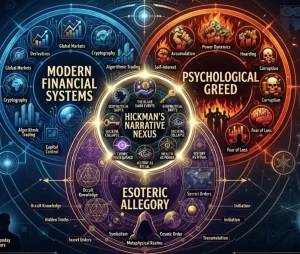
Unlike most graphic novels that treat finance as mere background noise, Jonathan Hickman weaves actual economic jargon directly into the narrative. Characters discuss:
-
Derivatives and Collateralized Debt: Explaining how complex financial instruments obscure underlying risk.
-
Leverage & Short-Selling: Showing how elite players profit off panic and market drops.
-
Liquidity Pools & Commodity Cornering: Demonstrating how artificial scarcity is created behind closed doors.
2. Allegory for Market Opacity
The series serves as an extended metaphor for real-world dark pools, shadow banking networks, and undisclosed institutional alliances. For readers in the financial sector, the blood-magic rituals of the Caisa family symbolize the opaque, cutthroat realities of deregulation and unchecked corporate power.
Key Themes Explored in the Series
-
The Cost of Unlimited Wealth: The narrative repeatedly emphasizes that extraordinary capital accumulation requires an equally extraordinary toll—usually paid in human lives, moral integrity, or institutional stability.
-
Mathematics Meets Mysticism: Hickman bridges the gap between algorithmic trading and ancient alchemy, suggesting that financial formulas are modern magic spells designed to command human behavior.
-
The Toll of Secrecy: Protagonists and antagonists alike suffer under the weight of maintaining double lives within hyper-elitist institutions.
Structure & Volume Overview
The Black Monday Murders is structured like a dense financial audit, blending traditional comic panels with redacted case files, organizational charts, stock graphs, and internal corporate memos.
| Volume | Issue Count | Primary Arc & Market Focus |
| Volume 1: All Hail Mammon | Issues 1–4 | Introduces Detective Dumas, the inner hierarchy of the Caisa Bank, and the ritual roots of the 1987 market crash. |
| Volume 2: The Scales II | Issues 5–8 | Expands into global commodity markets, corporate succession wars, and the geopolitical reach of the Ouroboros Circle. |
| Volume 3: The End of Days | Issues 9+ (In Development) | Focuses on the detective’s quest for truth amidst an impending, systemic global financial collapse. |
Critical Reception and Academic Commentary
The series has earned praise across media outlets for its unique fusion of economic theory and graphic storytelling.
According to The Comics Journal, the work “bridges the gap between specialist finance literature and popular graphic narrative, turning abstract economic models into visceral drama.” Furthermore, a research paper published in the Journal of Popular Culture notes that the series uses “speculative fiction to critique real-world market opacity, offering a psychological portrait of institutional greed.”
Real-World Takeaways: Lessons for Risk and Transparency
Can a graphic novel make you a sharper market observer? In an indirect way, yes.
Consider a real-world scenario: a junior market analyst notices an unexplained price anomaly in international wheat futures. While standard models might attribute the spike to weather patterns or supply chain delays, a reader of The Black Monday Murders is conditioned to look deeper—evaluating non-traditional risk factors such as geopolitical signaling, hidden cartel coordination, or undisclosed institutional liquidity shifts.
Ultimately, the series reinforces a crucial lesson for modern commerce: sustainable market health requires transparency, ethical oversight, and the courage to challenge opaque power structures.
Final Thoughts
The the series remains one of the most sophisticated graphic novel series of the modern era. By wrapping complex economic critique inside a compelling horror story, Jonathan Hickman provides a unique lens through which we can examine the hidden forces driving the modern financial world.
Related reading: see this related guide and compare more options here.
How to Apply These Lessons to Your Business
Start by listing the tasks that eat most of your week. Rank them by time cost, then match each one to a feature on your shortlist. Ask vendors for a live demo using your own data, not a canned sample. Check reviews from teams of your size, since enterprise feedback can mislead. Finally, test one option with a small pilot group before rolling it out to everyone.
Common Mistakes to Avoid
The biggest mistake is buying for features you will never use. Keep the stack lean and master the basics first. Another trap is skipping training, which leaves half the value on the table. Schedule one short session per week until the team is fluent. Review usage numbers monthly and drop tools nobody opens.
Final Verdict: Is It Worth It?
For most small teams, the answer is yes, provided you start lean and measure results. Pick one bottleneck, fix it well, then expand. Revisit your choice every year as pricing and features change. The detailed comparisons above give you a solid starting point.
Related Guides
See also 22 essential business tools to grow in 2024, the best business success, the best entrepreneur business models, growth business banking strategies, mastering the business brief.
What is Black Monday Murders about?
Black Monday Murders follows finance elites hiding occult crimes behind markets. The comic blends real history with dark ritual fiction.
Why do finance pros read it?
For Black Monday Murders fans in banking, its take on opacity and power feels familiar. It sparks debate on transparency.
Is it suitable for teens?
Mature themes and violence make Black Monday Murders adult fare. Preview issues before sharing.